

“You think you just fell out of a coconut tree?
You exist in the context of all in which you live and what came before you.“- Kamala Harris
You can’t escape Kamala’s coconut tree. The coconut will fall on you and will give you a concussion for trying to outrun history. The past isn’t something we can step away from; it’s the ground we stand on, the language we think in, the cities we inherit.
The line became a meme, but it’s true; nothing exists without context. Architecture, more than any other art form, should understand this.
Yet contemporary architecture behaves as if it has discovered an escape route. Designed with brand recognition in mind, it ‘boldly’ makes ‘iconic’ shapes built to raise stock prices and land value rather than engage with the history of site or discipline. These practices have moved away from viewing architecture as a form of anthropology, building as a record of culture, memory, and collective life, and instead adopted the model of economists. The focus is no longer on creating enjoyable useable spaces, but on the lead architect’s individual expression, on shock value and novelty. In other words, they’re superficial.
Botox buildings

These are what I’d call Botox buildings. This condition shows up everywhere, but it’s easiest to see in the buildings we celebrate most. Let’s take The Shard in London designed by Renzo Piano. It’s like a Hollywood actor pumped with fillers and Botox. Yeah, they don’t look 60 but they don’t really look any age at all. Now with people in their twenties doing these same procedures, they too don’t look any younger. Smoothed out and exaggerated, detached from the natural process of aging. They’ve opted out of time. They can’t look young and they can’t look old, they can only look plastic.


This is what happens when architecture is stripped from its historical context. The shiny exteriors lack the complexities and ambiguities that come from being part of a longer story. The novelty factor gets old quick. Newer, shinier, and stranger-shaped buildings pop up taking away the only interesting thing the building had going for it.
However, because it’s severed itself from anything deeper, it has no sense of cultural continuity and no historical breadth, these ‘new’ buildings will never age into timelessness; they just become not new.
The Rise of the Iconic Object
So how did this happen?
Part of this shift comes from the idea of the building as an object. In the 19th century, architects evolved the idea that buildings can act as public libraries, telling our history and values. Architecture was something readable. By looking at building you could understand the society that built it: what it valued, what it celebrated, what it hoped for.
The modernists changed this outlook. They rejected historical language in the pursuit of universal architecture. However, in doing so they erased local memory. They took the societal story and turned it inwards to an individual’s narrative. The building now tells its own story, not the story of the people. Maybe this would be ok if everyone could be involved in design, but the issue is that they never are.
Architecture as narcissism
From this ideology rose the Staritects, buildings became signatures and citizens unwilling audience members. When cities become galleries of ego, who are they really serving? Developers hire big name architects not because they believe in the power of good design, but because a recognisable name can brand a district and inflate land value.
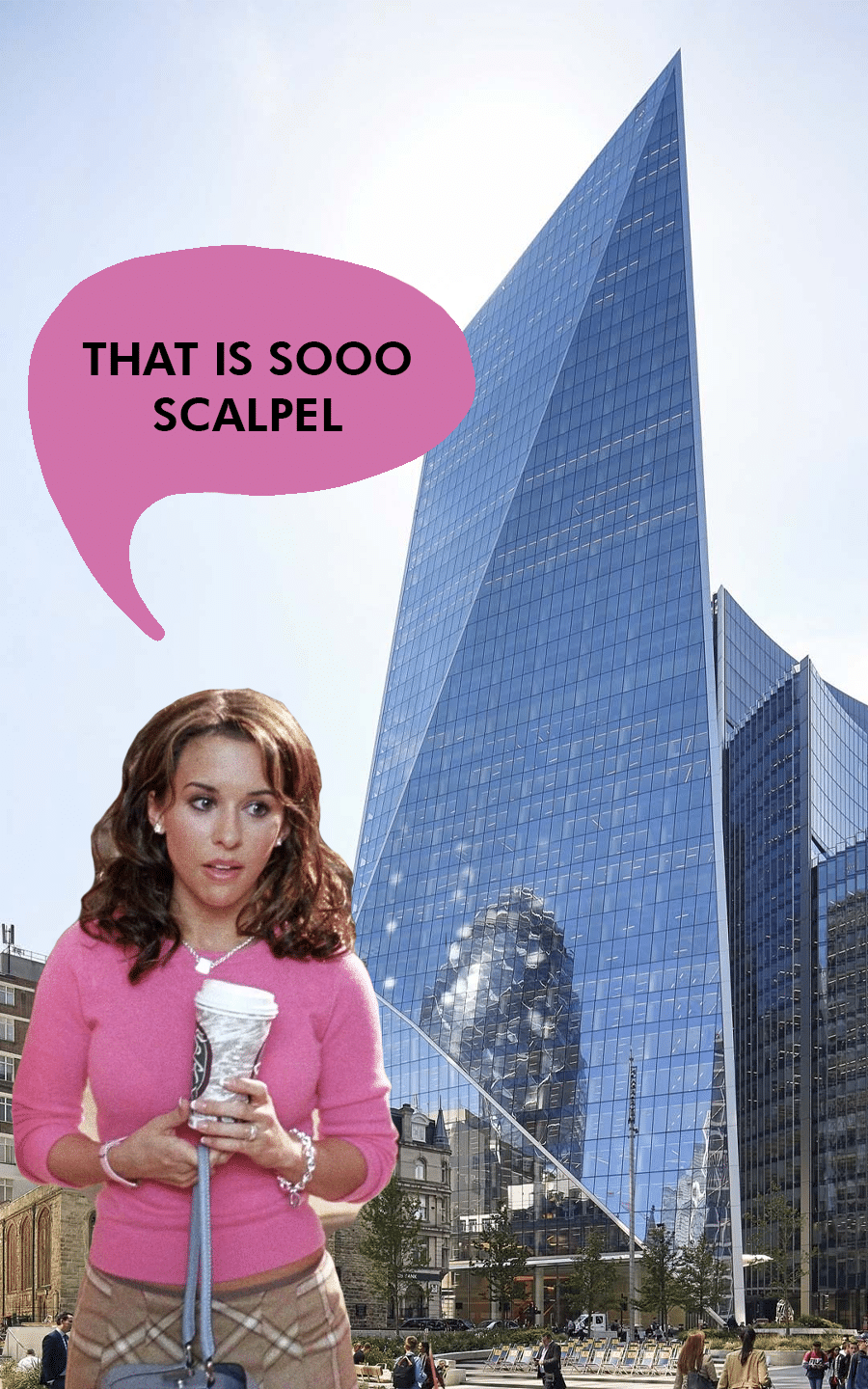
The developer-led thinktank that came up with the scalpel is mimicking the natural success of “the gherkin”, but because it’s forced it never stuck.
It’s the same logic as language. You can’t just introduce a word into the public lexicon through sheer egotistical will. It has to form organically through use and shared meaning.
To quote our realist queen Regina George “Stop trying to make fetch happen! It’s not going to happen!”.
Architecture works the same way. You can’t just declare something meaningful and expect people to care.
Take the high road
To understand the consequences of this shift, it helps to look at how buildings relate to time. In “How Buildings Learn” Steward Brand puts forth the idea of High-Roads, Low-Roads, and No-Roads.
High-Road architecture is stuff like Saint Paul’s, The British Museum etc. They’re monolithic independent buildings in the street façade, presenting a stable face to the city, and designed as part of a larger architectural history. Despite their façades remaining consistent, they are constantly reinterpreted with new uses or perceptions. As they age they gain depth, they become part of the story.
Following T.S. Eliot’s “Theory of Tradition and Individual Talent”, that when we build we are in dialogue with the past, what we build now changes the past as much as the past alters the present.
Tradition is a matter of much wider significance. It cannot be inherited, and if you want it you must obtain it by great labour.
– T.S. Eliot’s “Theory of Tradition and Individual Talent”
Meanwhile, Low-Road architecture sits at the other end. They’re the utilitarian buildings like shops, warehouses, and improvised spaces. Thrown up, torn down, constantly in flux. While these don’t have the fancy-pancy architectural references of ancient Greece and critical acclaim from the people up top, they’re alive. People reshape them, layer by layer, and in doing so, embed them with memory. Each iteration holds the history and culture of the current occupants. Both types, in different ways, participate in history.


Finally, there is No-Road architecture. These are the contemporary buildings. They aren’t in conversation with architectural history and they definitely aren’t in conversation with the local culture. They are conceived as complete objects from the start, neither designed to endure nor to adapt, but to remain economically relevant for just long enough to extract as much equity as possible. This means when their newly-made shine starts to dull, all that can be done is demolition or decay.
It’s built in obsolescence.
Disposable architecture mirrors a disposable culture. It’s not exactly shocking that this took off alongside neoliberal policies that treat everything, including cities, like something to be optimised, flipped, and replaced. As David Harvey calls it, this is “creative destruction,” a never-ending cycle of build it, extract value, knock it down, repeat. The city starts to feel less like a place and more like a never-ending group project run by property developers.
The No-Road contemporary building fits perfectly within this logic. It’s not only conceptually detached from history, but physically built to resist change. The systems are rigid with fixed layouts and inflexible facades. By the time you’ve figured out how to modify it, it’s already cheaper to bulldoze it, and due to high maintenance costs it can’t be left unoccupied. In this way, their disposability was not an accident but part of the business model.
Culturally, these buildings are equally shallow. Lacking the embedded references of High-Road architecture or the participatory openness of the Low-Road, there’s nothing for people to latch onto. No room to reinterpret, no space to make it their own. Their meanings are fixed in a kind of immaculate conception, delivered whole from the Staritect, and not to be touched.
The result is a building that cannot learn. It cannot enter into the slow, messy back-and-forth of history that T. S. Eliot describes, nor the adaptive cycles that Stewart Brand identifies. Instead, it operates within the closed loop outlined by David Harvey: value is extracted during its brief relevance, after which it is discarded, clearing the ground for the next iteration.
What good architecture does instead
The problem isn’t that they ignore history it’s that they remove the imagination of a future. Timelessness doesn’t come from escaping history, it comes from working with it. Key qualities include:
- They accept continuity rather than rejecting it
- They allow modification and change
- They welcome imperfection
- They are designed for unknown futures
- They participate in the memory of a place
- They invite public attachment
- They carry layered meanings
- They use materials that age with character

When a building has one or more of these, people begin to absorb it into their lives.
To the left is the big apple in Mumbles, Wales. Despite it being a little silly and would have you kicked out of architecture school for presenting it, the apple has become a timeless icon for the local people. It started out selling cider. Over time, it adapted and has gone on to sell ice creams and other treats. For nearly a hundred years this little structure has been in the summer memories of every kid from Mumbles. It’s changed with the people, and fits their humor. It’s part of the urban memory. That’s something no iconic object can manufacture.
Return to the coconut tree
No buildings fall out of coconut trees. They exist in the context of everything that came before. The buildings that survive aren’t the ones that try to escape history, but the ones willing to be changed by it.
So when you build like that context doesn’t exist, don’t be surprised when a coconut comes straight through the roof.
Thank you for reading!
If you enjoyed this you can read more opinion articles here.


