

Have you started designing your building and stuck on how to add environmentally friendly design features? Here’s a list of interesting sustainable solutions you can add to your project.
The key idea behind all of them is passive environmental control (doesn’t involve mechanical or electrical systems) and circular lifecycles.
- Passive ventilation
- Passive cooling
- Passive heating
- Recyclable materials
Thermal mass
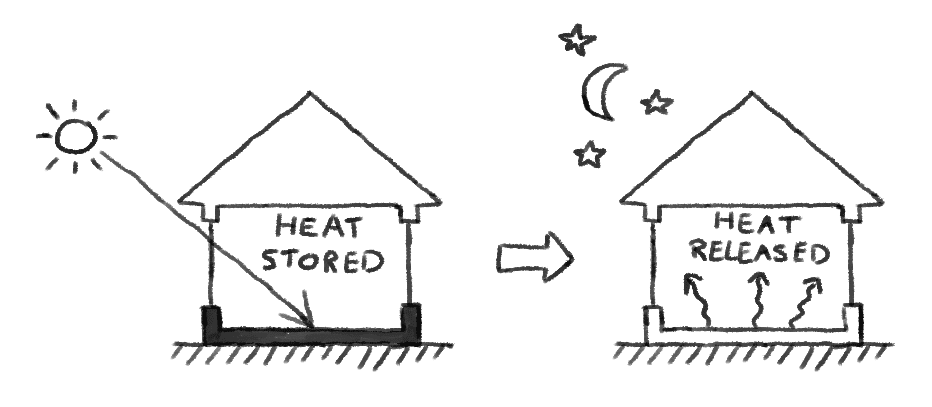
Thermal mass is a characteristic of a material describing its ability to absorb, store and release heat energy. By using high thermal mass materials in areas that receive a lot of heat from the sun or machinery, you can passively thermoregulate the building as they absorb heat as temperatures rise and release it as they fall. Common choices include:
- Concrete
- Brick
- Stone
- Water
- Rammed earth
Trombe Wall
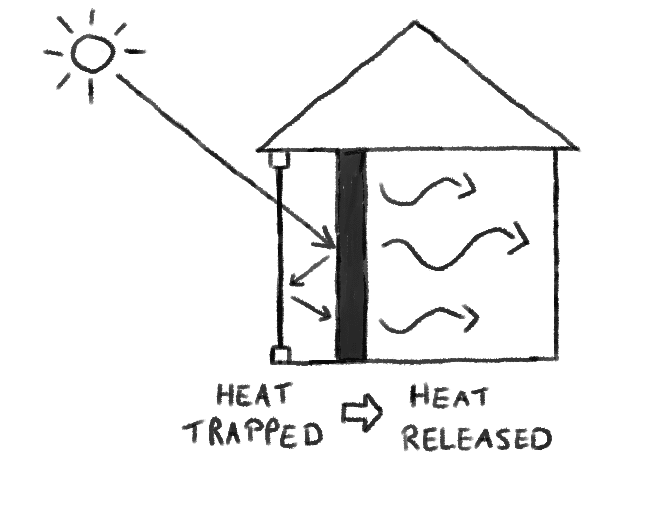
A Trombe wall utilises thermal mass and glass to store the heat from the sun to passively heat the building.
By facing a wall with good solar absorption and thermal mass (a matt, dark coloured and dense material) towards the sun it will absorb a lot of heat during the day. A Trombe wall then places a plane of glass in front of it with a narrow gap in-between. The glass protects the wall from external conditions and allows for sufficient airflow while also trapping the long-wave infrared radiation (the heat) in. This is similar to the greenhouse effect. The trapped heat is slowly released into the building through radiation and convection.
There are several extras you can add such as adjustable vents in the wall to allow for more rapid heat transfer into the building or thermal systems to generate hot water. For cold nights adding insulated shutters to the glass will massively reduce heat loss. Alternatively in hotter climates, you can add overhangs on the exterior to limit peak solar energy gains during the day.
Thermal labyrinth
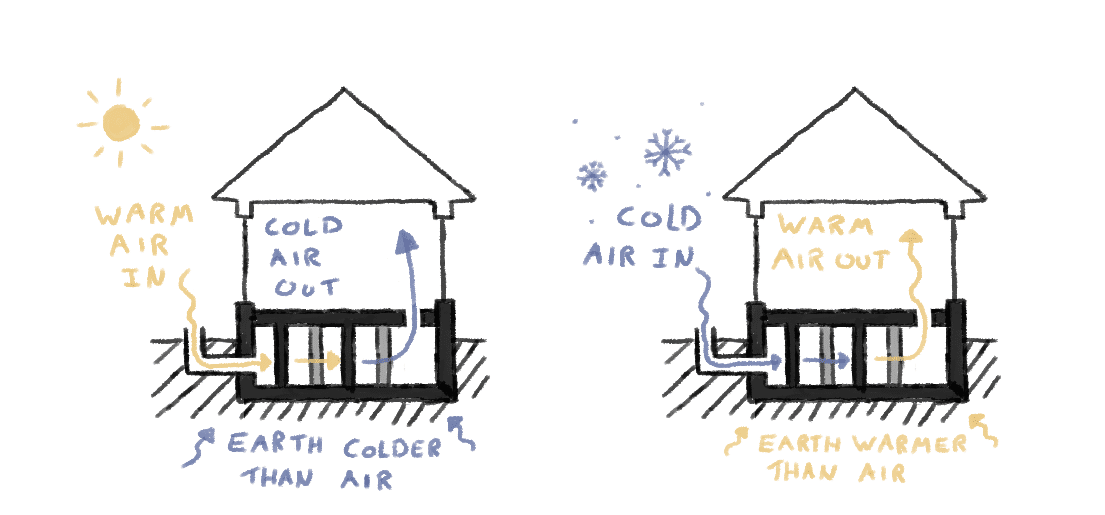
A thermal labyrinth is a structure placed under the building to keep it cool in summer and pre-heat the air in winter, it works especially well in climates with high temperature fluctuations. Through high thermal mass and surface area, the cold earth keeps the labyrinth at a stable temperature which then passively heats/cools the air.
Louvres
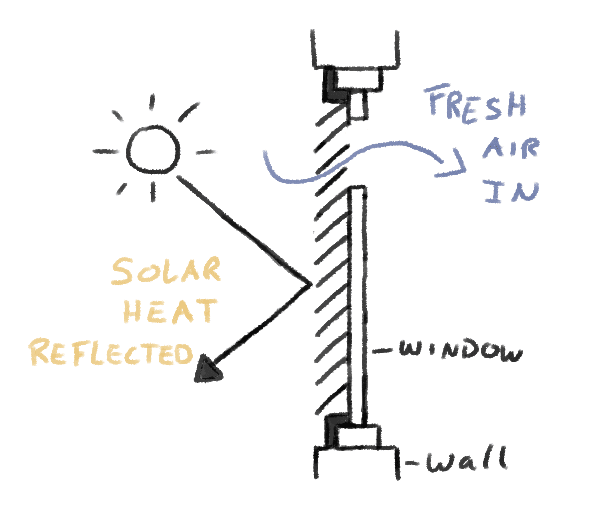
Louvres are narrow, sloping slats put in front of openings such as windows or vents. They are primarily used in hot climates as they provide solar shading while allowing air flow into the building. However they can also be used to give protection from harsh winds and rain.
Jalousies are louvres that are adjustable giving the occupants more control over when they want open or shuttered openings.

Cross ventilation
Cross ventilation is when pressure differences between one side of a building and the other draws fresh air through the building, helping to control internal temperatures and reduce moisture accumulation.
This commonly happens by including windows and vents on the walls perpendicular to the prevailing wind. Fresh cool air in pulled into the building on the high pressure windy side and stale warm air is pushed out of the low pressure leeward side.
While it’s a easy method of providing passive ventilation it has some draw backs such as
- not being very effective of hot still days as little pressure difference
- only suitable for narrow buildings (width maximum five times the floor-to-ceiling height) with no internal walls blocking airflow
Stack ventilation
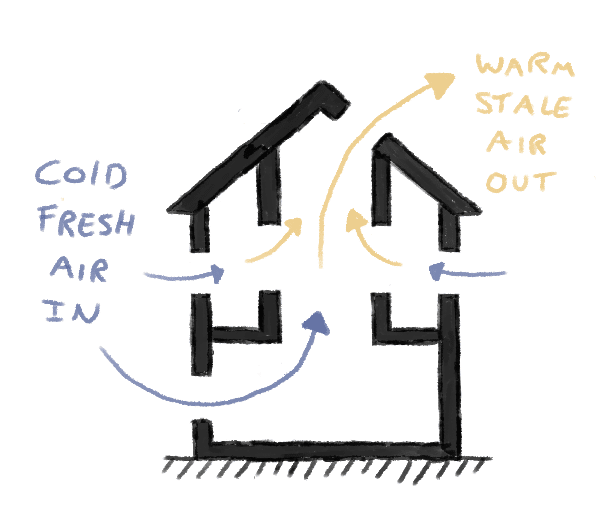
Stack ventilation utilises the “Stack Effect” which is the phenomenon describing how hot air rises as it’s less dense than cold air.
By introducing openings at the bottom and top of the building, fresh cold air is drawn into the building at the bottom and the hot stale air rises out at the top. This passively ventilates the whole building. It’s very effective in tall and deep buildings in which cross ventilation isn’t enough to provide adequate airflow. However, it does require the internal temperature to be hotter than the outside. Examples of stack ventilation are central atriums, ventilation stacks and wind catchers.
Passive water cooling
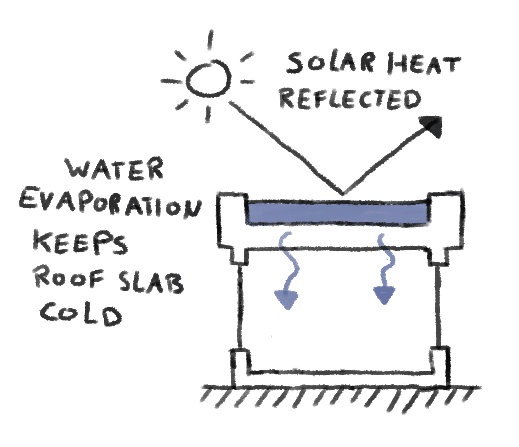
Water is a great temperature and humidity regulator. By adding water features into your design, they will passivily reflect solar rays and act as a heat sink, naturally cooling incoming breezes through convection and evaporation.
There are several ways to add water cooling to your designs. The most common being decorative water features such as ponds, fountains and channels.
Other ways involve misting porous structures to provide evaporative cooling similar to the “zeer pot” system.
Becoming more common are roof ponds. They have a high thermal mass with the added bonus of being able to be covered. For example in the summer the pond can be covered during the day to prevent solar gain. At night, the cover is removed, allowing the water to release stored indoor heat via evaporation and radiation, cooling the building. Alternatively in the winter it can be uncovered during the day to absorb solar radiation. While at night, being covered to retain that heat, which radiates into the house.
Eco-materials
Material scientists are coming up with new sustainable materials every day. Using materials that has a low carbon footprint or can be fully recycled at the end of the building’s life can drastically improve the buildings sustainably. Examples include:
- Mushroom bricks: Sustainable, organic bricks made from mycelium (fungi root structures) and agricultural waste. They are grown in molds rather than fired, resulting in lightweight, fire-retardant, and biodegradable blocks that can exceed the compressive strength of concrete.
- Bioplastic & Biomaterials: Materials derived from waste, such as wine corks, seaweed, Potato chipboard, or Knotweed panels, provide new ways to recycle waste into sustainable building materials
- Ferrock & Bio-concrete: Ferrock is concrete alternative made from recycled steel dust that locks in C02. Also bio-based concretes such as ones using waste oyster shells are a great way to use concrete within your building without the creating the usual large C02 impact of regular concrete.
- Translucent wood: An upcoming material that creates a translucent plastic-like material stronger than glass and more biodegradable than plastic.
- Light-reflecting concrete: By adding clear reflective beads to the concrete, it can increase it’s solar reflectance, reducing the Urban Heat Island effect.
Grey water collection
By introducing grey water systems into your building you can drastically reduce the buildings water demand. These systems collect and reuse rainwater and greywater (the wastewater from showers & sinks) in place of mains water.
Green roofs
Finally, everybody’s favourite, stick a green roof on top of it!
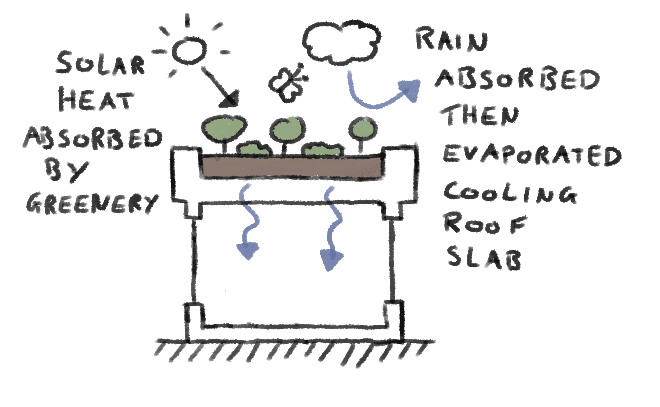
Green roofs are when you add a garden on to the roof of a structure. They are split into “Extensive” (Shallow, lightweight systems requiring low maintenance, suited for inaccessible roofs.) and “Intensive” (Deep, heavy systems needing high maintenance, often designed for recreation).
Green roofs are great for sustainability as they work as natural insulation and help boost biodiversity within urban environments. In addition to this they act as sponges, retaining rainwater and reducing the strain on sewage systems, thus decreasing flood risk.
Hybrid sustainable systems
Some projects are so complex that passive systems aren’t enough to maintain the needed environment. This is where hybrid systems come in. They are mechanical systems that are much more sustainable than traditional methods like AC. These include heat recovery ventilation, solar thermal systems, solar panels and ground source heat pumps.
Using a variety of these solutions will help your building become more eco-friendly and sustainable. For more in-depth strategies look at Passivhaus which is the gold standard of net-zero construction.
Thank you for reading!
Let me know down below if I’m missing any solutions you love to see in buildings.
For more resources on designing click here



Thank you, this was very informative. It made me think of using water as the thermal mass in my Trombe wall.
I’m glad you found some useful information 🙂 A water wall would look beautiful, such a great idea!