

Stand on London Bridge and look up at the Shard.
Renzo Piano’s glass splinter has loomed over this stretch of the Thames since 2012, and in that time something strange has happened to it: nothing.
It looks exactly as it did on opening day. No patina, no weathering, no sense that the city has absorbed it or left any mark on its surface. For a building this size, in a city this old, that should feel like an achievement. Instead it feels like a problem.
I call buildings like this Botox buildings

Botox buildings
Like a face smoothed to remove every sign of ageing: controlled, sealed, not a muscle permitted to move. The Shard can’t look young and it can’t look old. It can only look plastic. It sits slightly outside time the way a Botoxed face sits slightly outside age. In trying to resist the process of ageing it has opted out of the process that makes things human.


That process is context. The past isn’t something a building steps away from, it’s the ground the building stands on, the street it faces, the memory of everyone who walks past it. Strip that away and what remains is image without depth: a shiny exterior that lacks the complexity and ambiguity that comes from being part of a longer story. It creates this eerie effect where they don’t look like they belong to any particular time or place. By opting out of time, they lose the process by which buildings become meaningful.
Despite the forever frozen face, the novelty factor gets old fast. Newer, stranger, taller buildings keep arriving, and the only thing the Shard had going for it, being visually arresting, now belongs to someone else. It severed itself from anything deeper than its own image, so it has no cultural continuity to fall back on. These buildings will never age into timelessness.
They will just become not new.
The rise of the iconic object
So how did this happen?
Part of this shift comes from the idea of the building as an object. In the 19th century, architects evolved the idea that buildings can act as public libraries. Buildings were readable. You could look at a civic structure and understand the society that built it: what it celebrated, what it feared, what it hoped its grandchildren would inherit. Architecture was anthropology in stone.
The modernists changed this. Chasing a universal architecture stripped of historical ornament, they cut the thread connecting buildings to local memory. The intention was liberation. The effect was severance. They took the societal story and turned it inwards to an individual’s narrative. The building now tells its own story, not the story of the people. Maybe this would be ok if everyone could be involved in design, but the issue is that they never are.
From that severance, the Staritect emerged.
Galleries of ego
Buildings became signatures and citizens unwilling audience members. When cities become galleries of ego, who are they really serving? Developers hired big name architects not because they believe in the power of good design, but because a recognisable name can brand a district and inflate land values.
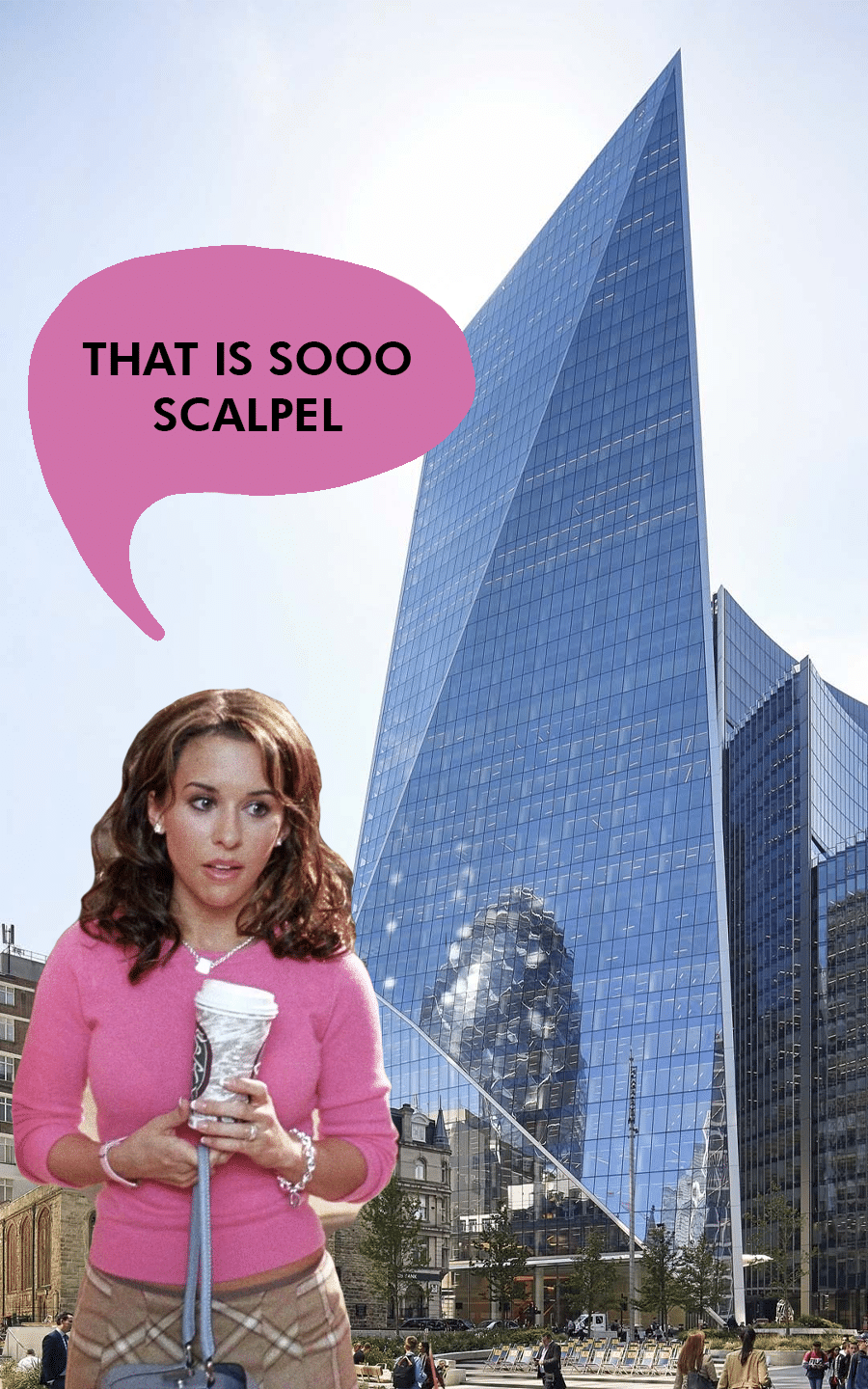
Think of the Scalpel, that glass wedge near Waterloo that nobody asked for. A developer-led thinktank tried to manufacture the organic cultural cachet of the Gherkin, a building that earned its place in London’s imagination precisely because it arrived on its own terms rather than as a calculated imitation of success.
It’s the same logic as language. As Regina George would say: stop trying to make fetch happen. It’s not going to happen. You cannot declare something iconic through sheer egotistical will and expect people to care. Meaning forms organically, through use and shared life, or it doesn’t form at all.
Three roads
To understand the consequences of this shift, it helps to look at how buildings relate to time. Steward Brand in How Buildings Learn puts forth the idea of High-Roads, Low-Roads, and No-Roads.
High-Road buildings endure: Saint Paul’s, The British Museum etc. They’re monolithic independent buildings in the street façade, presenting a stable face to the city while their meaning accumulates quietly over centuries. Despite their façades remaining consistent, they are constantly reinterpreted with new uses or perceptions.
Their facades don’t change much. Everything else does. T.S. Eliot understood this when he wrote that tradition cannot be inherited; it must be obtained by great labour. High-Road buildings are the physical form of that labour. They’re always in conversation with what came before, and that conversation keeps them alive.
At the other end sit Low-Road buildings. They’re the utilitarian buildings like shops, warehouses, and improvised spaces. Thrown up, torn down, constantly in flux. Nobody celebrates them and an architecture school wouldn’t look twice, but they are genuinely alive. People reshape them, layer by layer, and in doing so, embed them with memory in a way that no designed building can manufacture. Each iteration holds the history and culture of the people who lived inside it. They change with the people, and that is their whole point.
Both types participate in time. One through endurance, the other through adaptation. Both accumulate meaning. Both belong somewhere.


The no-road
Between them, or rather, outside them entirely sits No-Road architecture. Which is where most of what gets built today lands.
No-Road buildings arrive as complete objects, they aren’t in conversation with architectural history and they definitely aren’t in conversation with the local culture. Designed neither to endure nor to adapt but to stay economically relevant for just long enough to extract as much equity as possible. When their newly-made shine starts to dull, all that can be done is demolition or decay. The business model depends on this. Adaptation is expensive; demolition is often cheaper than maintenance; the whole cycle runs on extraction rather than continuity.
David Harvey calls this creative destruction: the continual process of building, extracting, and replacing that neoliberal urbanism needs to keep functioning. The city stops feeling like a place and starts feeling like a revolving set. Skylines rising and falling within a decade, each development clearing the ground for the next, nothing accumulating, nothing remaining long enough to mean anything.
It’s built in obsolescence.
The buildings themselves reinforce this. Rigid systems, fixed layouts, inflexible facades, all of it physically built to resist the modification that might give them a second life. By the time anyone works out how to modify them, it’s already cheaper to bulldoze. Disposable architecture mirrors a disposable culture. It was not an accident or a failure of design but part of the business model.
Culturally, the results are equally shallow. Strip out the embedded references of High-Road architecture and the participatory openness of the Low-Road, and nothing remains for people to latch onto. No room for reinterpretation, no space to make it their own. The meaning arrives fixed, delivered whole from the Staritect, immaculate and untouchable, and therefore dead on arrival.
The result is a building that cannot learn. It cannot enter into the slow, messy back-and-forth of history that T. S. Eliot describes, nor the adaptive cycles that Stewart Brand identifies. Instead, it operates within the closed loop outlined by David Harvey: value is extracted during its brief relevance, after which it is discarded, clearing the ground for the next iteration.
What endures
There is a building in Mumbles, on the Gower Peninsula in Wales. It is a large fibreglass apple. It has sold cider, and later ice cream, to generations of local children for nearly a hundred years. It has no architectural pedigree, no critical theory behind it and would probably have you kicked out of architecture school is you presented it. By any formal measure, it is completely ridiculous.
It is also, in every way that matters, timeless.

The Big Apple in Mumbles works because it changed with the people who used it. Adapted its contents, absorbed its local context, became part of the summer memory of everyone who grew up nearby. It participates in the life of the place. It carries meaning that no developer commissioned and no architect designed, because meaning of that kind cannot be commissioned or designed. That kind of meaning has to be earned, slowly, through use.
Context is Not Optional
Contemporary architecture systematically destroys the conditions for this. Not through malice, but through the application of a logic that treats buildings as assets rather than places. As temporary vessels for extractable value rather than containers for human life.
The buildings that last are never the ones that tried hardest to last. They are the ones that stayed open to modification and reinterpretation, to uses nobody predicted when they broke ground. They accepted that they couldn’t control their own meaning. That control is what kills the Botox buildings. In trying to fix themselves permanently, they remove the one thing that might have given them a future: the possibility of change.
Every building exists in the context of the city that preceded it, the culture that produced it, the history it either engages with or pretends isn’t there. The site holds a memory whether you acknowledge it or not. The city has been having a conversation for centuries, and when you build you are either joining it or interrupting it.
Build as if history doesn’t exist, and history will make its point without you.
Thank you for reading!
If you enjoyed this you can read more opinion articles here.



.JPG)