

Digital architecture’s feudal future
You know the bookshelf. The one that lives behind you on work calls. Full of books that look intellectual but haven’t been read, performatively nestled against the panic-bought monstera that has just enough maintenance to signal you’re a person with their life together. You shoved a desk against the only wall with enough ambient lighting so your colleagues don’t call the crisis team after broadcasting your dark circles at the 9am catchup. It’s called working from home. In reality, it’s working from a stage.
That little work nook, built for the rectangle of the camera frame, is only the beginning. Before you’ve said a word to anyone, you’re checking your phone notifications. Pouring your morning coffee to the symphony of the iPhone Marimba. Work and life are now a simple swipe away from each other.
Despite what all the lifestyle coaches want you to think, this is not a personal failing. It is an architectural one. Our digital lives mirror the development of the physical world, and we’re just stepping into the digital-industrial age whether we chose to or not.
The room that does everything
Architecture doesn’t lie about economics. Every plan, every threshold, every decision about where the wall goes and what happens on either side of it records how a society organises its labour. You can’t hide that under mission statements or a rebrand. Buildings are, in this sense, the most honest documents we have.
The medieval peasant lived in one room. By day it was a workshop. By nightfall the tools went to the walls and it became a home. This wasn’t poverty of imagination, it was the building being honest about the economy it served. Labour and rest shared a floor because they shared a life. The room did everything because the economy demanded everything from the room.
Then the industrial revolution broke that arrangement. The mill required bodies in a specific place at a specific time, and that requirement reorganised the entire urban landscape. Towns grew up around factories. Streets ran toward them. The terraced house, replicated across the country, was designed around the shift pattern: close enough to walk, dense enough to house a workforce, cheap enough to build at scale. The economy changed, and the buildings followed.
The information age produced another shift. Physical goods gave way to digital information. Brick chimneys gave way to glass towers and the hospitality buildings that orbit them. Then in 2020 the laptop went on the kitchen table and it was over in an afternoon. We regressed to the much older arrangement. Work and life stopped being separated by space and started being separated by time. The room, once again, did everything.
The enclosure acts of the internet
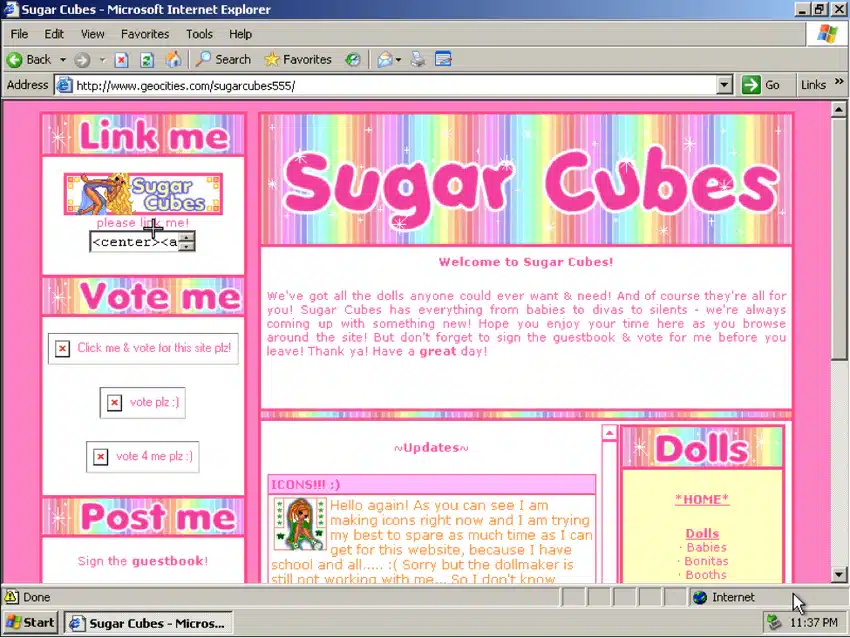
Cast your mind back to the early internet. GeoCities. Angelfire. Forum threads about nothing that ran to forty pages. Fan sites held together with bad HTML and genuine obsession. The web was common land, ungoverned and entirely yours, and it was brilliant.
Then San Fran tech closed the commons.
The mechanism was identical to the one that cleared the English countryside between the sixteenth and nineteenth centuries. The Enclosure Acts didn’t tell the peasant they were being dispossessed. They were told that the new arrangement was more efficient. The effect was that the peasant would still work the land, but lost the freedom and ownership of their labour. Facebook made the same argument in different language. Why maintain your own site when we’ll host everything for free? Why build when you can post? Platform capitalism dispossessed the early internet not through violence but through convenience, which is always more effective.
What replaced the commons was a workhouse. An infrastructure that inhabits you: it sets the pace, dictates the format, monitors the output, extracts the value. The algorithm is the foreman. It punishes inconsistency and rewards compliance. It decides, on any given day, whether your work reaches the people you built an audience to reach. You have no appeal, no union. You have, if you are lucky, a monetisation threshold and a content policy that changes without notice.
Silicon Valley lured us in with office slides, ping-pong tables and kombucha. But the architecture of the tech campus is the architecture of the mill owner, designed to keep one class of people comfortable while another class, distributed across ten million spare bedrooms, does the actual work.
We did not lose the internet. We were moved off it, gradually and by consent, into a new-age enclosure.
The workhouse in your pocket
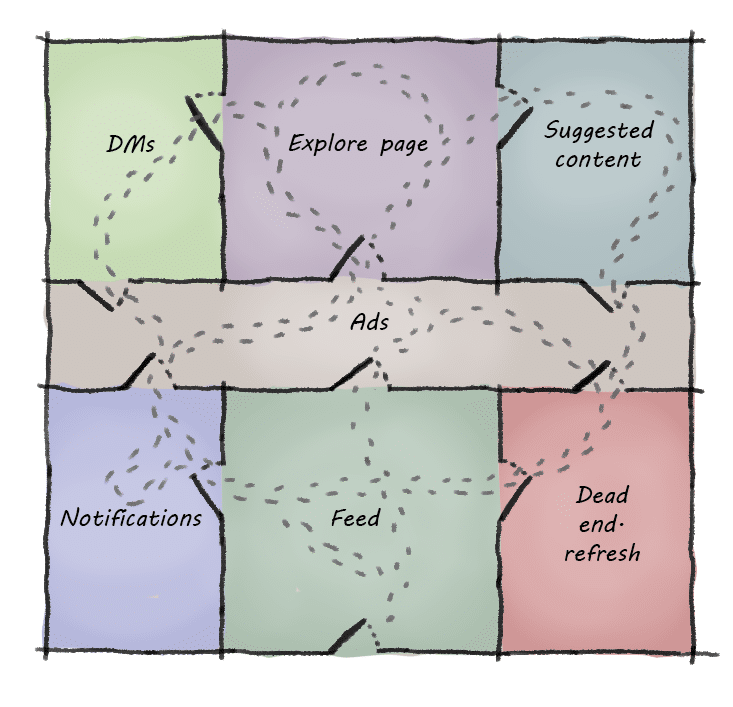
Consider what the algorithm is spatially: a floor plan. It determines where you can go, what you see, and how long you stay.
It sets the format and pace of production. A vertical video performs differently from a horizontal one, a three-second hook performs differently from a slow build. You did not choose those proportions, like the mill worker, you turn up to work at the loom given to you.
The content creator is not a free agent operating on a platform. They are labour operating within a designed space of extraction. The language of the industry obscures this with considerable determination. The creator economy. The personal brand. The audience you’ve built. All of it framed around ownership and autonomy, around the flattering idea that you are running a small business rather than staffing someone else’s factory. But pull back the language and the structure is the same. You receive a share, subject to terms that change without negotiation, distributed through a system you cannot audit, in an environment you cannot own. The Victorian mill owner called his arrangement a fair wage. The platform calls its arrangement monetisation.
What the workhouse added to poverty was shame. It was designed to make destitution feel like moral failure, to attach stigma to the condition of needing it, so that the people inside it would internalise the logic of their own subjugation. The platform does something subtler. It attaches identity to the condition of producing for it. Your follower count is your worth. Engagement rate is your value. Your consistency, your growth, your reach: these are not metrics the platform invented for fun graphs, they are the new mechanisms of shame. Fall behind and you aren’t just unproductive. You are publicly failing.
The new factory floor
The logical conclusion of all of this is a building in Jakarta. A company called Ecomobi opened what it calls a Livestream Factory in the Indonesian capital in 2026. The name is not a metaphor. The building runs twenty to twenty-four hours a day. Six premium streaming rooms, each roughly fifty square metres, every surface calibrated for the platform’s preferred aspect ratio. Makeup rooms. Training rooms. A returns desk stacked with products to unbox. The backing wall pre-lit at the angle the algorithm rewards. The operatives arrive with follower counts instead of punch cards. The shift pattern is set by a foreman called the algorithm.
It is not an anomaly. The parent operation in Vietnam runs a 4,000-square-metre livestream complex generating over 13,000 streaming hours a month with a team of more than 150 hosts. Ecomobi plans to scale the Jakarta site to 2,000 square metres and forty streaming rooms. Whole districts in Guangzhou have already reorganised their urban fabric around content production at this scale. Not from a planning document or an architectural manifesto, but from economic logic. Individual creators need controlled light, clean audio, reliable bandwidth, proximity to logistics. Clustering them makes financial sense. The mill towns of the Industrial Revolution were built on identical reasoning.
What this building makes visible is the distance between two fictions. The first is that you are an independent running your own business. The second is that the spare room is yours.
The Pop-up manufactory
London has not yet built its digital-mill towns, but it is building their prototype, ironically in the same factories of the first industrial age. It’s happening in every warehouse conversion in Hackney with a cyclorama wall and a daylight studio. The Shoreditch pop-up with a neon sign and a designated insta photo corner. All the immersive brand experiences in Battersea designed not for the visitor standing inside them but for the visitor’s phone, held at the angle the space was built to flatter. These are not entertainment venues with a social media problem. They are early industrial architecture, feeling its way toward a typology that doesn’t have a name yet.
The BBC needed one Broadcasting House. The creator economy needs ten thousand of them, distributed, accessible, and owned by someone. The question is, who is that someone?

What comes after the factory

The first industrial age brought exploitation on a scale the world had never seen. Slums and poverty that consumed lives in a conveyor belt. Society moved past it only because someone made the case that the person who spent twelve hours at a loom was still a person who might want to read, to learn, to make something that was not owned by their employer. The buildings that resulted were not perfect. But they were public, and they were dignified, and they understood that the people using them were citizens rather than units of production.
The precedent for what comes next already exists. The Public Lending Right scheme has paid authors for library loans of their work since 1979, distributing more than £6 million a year to over 22,000 rights holders. The principle is simple: when public infrastructure is built on private creative labour, the creator has a legitimate claim on what that infrastructure extracts. The DCMS’s new Music-in-Libraries programme takes the argument into the built environment, putting recording studios and mixing desks inside public libraries, free to use, funded by the state. It is a music scheme. But the logic is the same: The means of production belong in public buildings. The library understood this about books in 1850. We are only now beginning to apply it to the tools that replaced them.
Will we let history repeat itself?
We are building the infrastructure of a new industrial class in real time. The media production centre is coming. The economics are too clear and the demand established. The only open question is who builds it, on what terms, and for whom. A content campus in Zone 2 owned by a real estate investment trust and leased back to creators at market rate is one answer. A municipally funded production facility, owned by the borough and accessible on fair terms, is another. The difference runs deeper than aesthetics. The difference is structural, an structure, in the end, is architecture.
The architecture profession has not yet made this argument with any seriousness. It has been too busy designing the headquarters of the companies doing the enclosing. The same discipline that gave us social housing gave us the tower block clearances that destroyed the communities it claimed to be rehousing.
The commons were enclosed once. We are watching it happen again, one warehouse conversion at a time. What gets built in the next twenty years will reflect decisions being made right now; By planners, by developers, by a profession that still has time to choose a side. The digital industrial revolution does not have to follow the same road. The question is whether architecture clocks in for a quick pay cheque or turns up to demand something better.
Thank you for reading!
If you enjoyed this, check out my other opinion pieces and let me know in the comments your thoughts on the new industrial age.