

Architecture’s only martyr was a gender neutral toilet
An ode to “Divisible by 2”
You step into a unsuspecting courtyard and there it stands, a simple building with two doors labelled ‘Man’ and ‘Woman’. What do you think is through those doors? Ordinarily it would be a a toilet block, that is what our many years of navigating cities has taught us, we read these signs instinctively. The ordinary and it’s signifiers run deep within us, collected in our culture and politics. So much so that when the ordinary is disturbed it makes people very uncomfortable, uncomfortable enough to get violent.
The ordinary is political
John Whiteman’s “Divisible by 2” was not just a structure but an experiment in perception, a confrontation with the politics embedded in architecture. In 1988, the ‘Geburt einer Haupstadt’ (birth of a Capital) Exhibition showcased the pavilion celebrating moving the state capital from Nieder-Ostereich (lower Austria) to the less cosmopolitan town of St. Polten.
From the outside it appeared unremarkable; a simple box construction with two large metal doors on each wall. Each pair of doors had ‘Man’ and ‘Woman’ written on them. However, once inside you are confronted with the fact that all doors led into the same empty space.

The work caused much controversy, managing to unite both the left and right political parties in their outrage. The heated discussion ended when the piece was fire bombed on the 24th July 1988, not even lasting a month on display. A powerful reminder that even the most ordinary symbols, when disrupted, can provoke extraordinary reactions.
To my knowledge this is the only building that has been martyred in the name of architecture. I think it’s important to analyse why this piece of architectural theory had such a violent end and why it has faded into the unknown rather than granted architectural saint hood.
The Performance of a Lifetime
The concept of the pavilion was that all architecture is political, it’s just that 99.9% of buildings are going along with the conservative power systems already in place. We don’t see day-to-day design choices as political because they are so ubiquitous. By disrupting the ordinary, he hoped to show the user the power hidden in the banality of ‘that’s just how its done’. Reminding us that ordinary architecture isn’t natural. Architecture is always man-made, its a constructed affair and with that comes our constructed beliefs.
With ‘Divisible by 2’ Whiteman proposes that disrupting the ordinary “will trigger the transformation of the subject from user to performer”. Similar to when a stage production goes wrong, the actor can’t go through the motions of reciting the rehearsed play like they’ve done every night this month, now they must truly perform. It is also a reference to Simone de Beauvoir’s work on social construction. When both gender doors lead to the same space, do you continue to perform wo/manhood or do you give up the performance entirely.
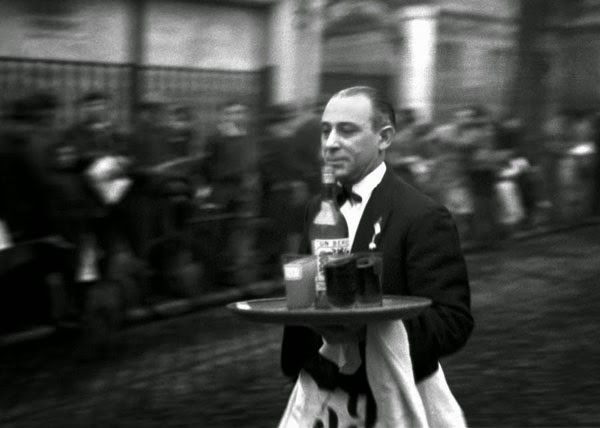
Sartre’s waitor
Remove the waiter iconography from him and he is no longer a waiter but a man. Remove the man iconography from them and they are no longer a man but a person.
We talk about transparency a lot in architecture. The most common way goes back to the modernists who linked the physically transparent (being able to read the materials and construction) to the metaphorical (being honest and moral). However, its not true. Real transparency isn’t seeing how the building is made but in seeing how the performance is made. That is pure honest construction. This project shows us that the subject is made inside architecture. It’s the inhabitant performing that activates the architecture, transforming it into the political. Architecture is truly political when it forces a choice where a habit once lived.
The Construction
Whiteman used many different motifs to engage the inhabitants in the ordinary. He designed the pavilion to be completely disfigured from our current reality: columns that raise and lower by two feet, wall panels that can be pulled and pushed from the frame, and ceiling panels that rotate inwards, closing in on the space. These modifications can be set to a subliminal one degree off or to a completely extreme ‘other’ experience. For the exhibition they chose to create a slight uncanny experience.
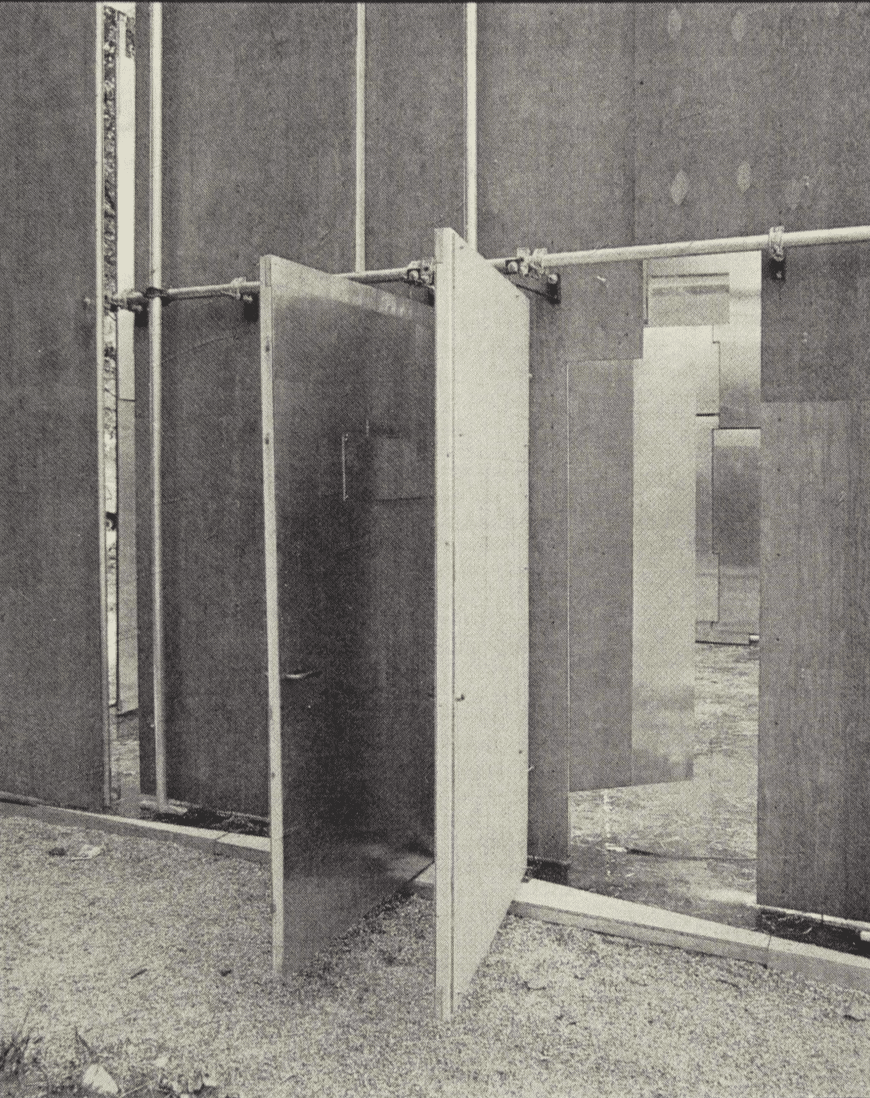
When you first enter the building it forces you off center through gendered doors. Stepping through you’re faced with a convex wall that, at first, appears a single orthogonal plane. You believe you’re at the center and the other sex is off to the side. However, when you move forward the illusion breaks with the reveal of the second surface. You realise your perception is wrong. You’re not at the center, and the other gender isn’t off to the side; They’re having the same but mirrored experience as you.
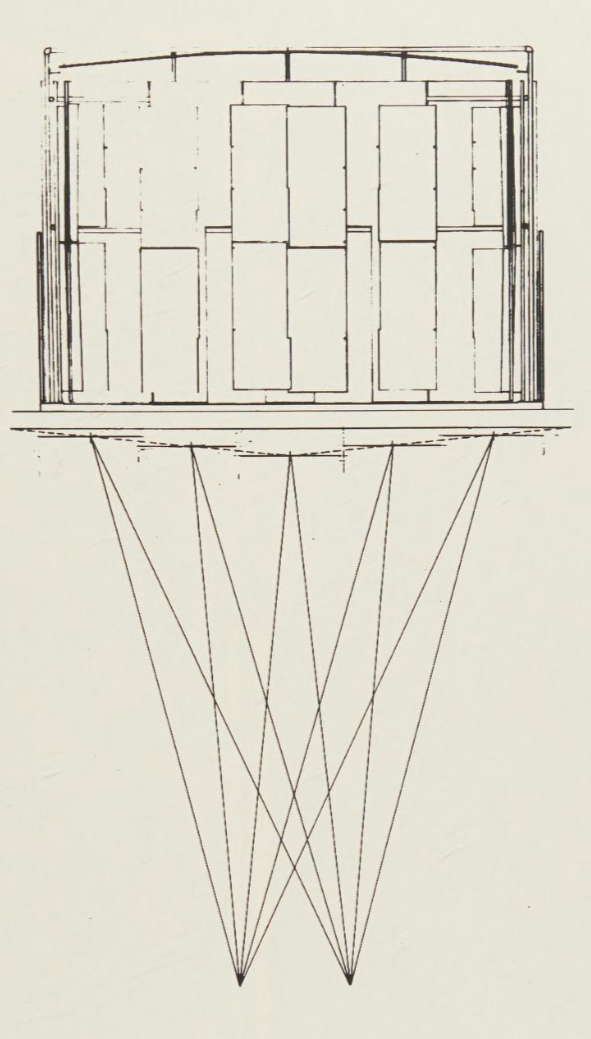
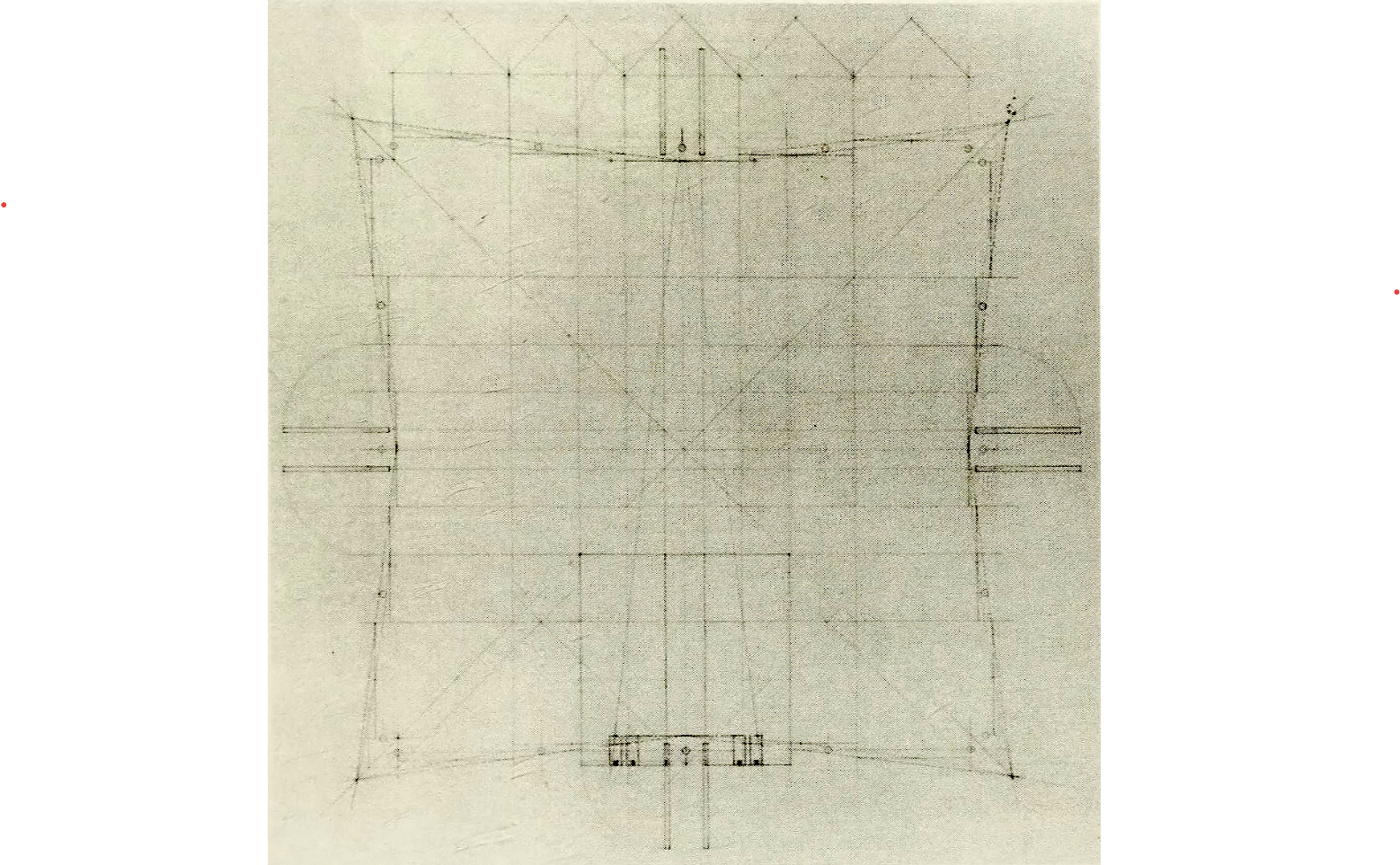
The interior is made of chaotic interlocking mirror like metal panels. You turn away from one and face another, your own face being inescapable. Dizzying as it brings out a painful self-consciousness of not only your occupation of space but your participation in the space. Being at the center becomes almost unbearable. Most try to settle back against one corner so they can regain the sense of being a viewer than a participant. Unfortunately for them, the gutters pour rain water into the corners. This creates a whirlpool effect pulling and pushing the inhabitants around the space.
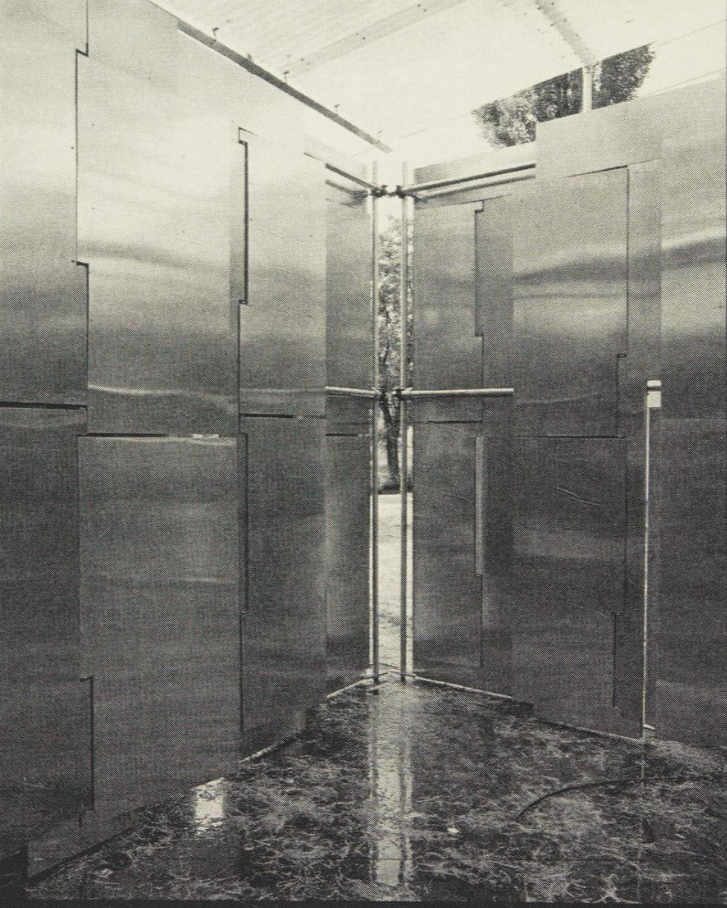
Gender Disaffirming Doors
The centerpiece of the project. The doors “act as titles for the building”, in that they hold the entire concept within them. At first glance they are dividing the sexes but if studied the two doors become one unit, quietly announcing that the “Man” and “Woman” labels are false from the very start.
When closed the two metal faces become an uninterrupted sheet. Scratches, burns and dents corresponding to vulnerable points on the body such as knees, genitals, stomach, breasts, eye, and head. These spread across both doors, making each dependent on the other to complete its own composition. Already the betrayal of ordinary expectations are hinted at.
The doors are the architecturalisation of Derrida’s deconstruction of gender. To understand woman you have to define it against what it isn’t, man, creating a plurality of definition. There can never truly be a definition of (wo)man as they coexist in constant flux of conversation. The doors show that men and woman are the same, they are not separate but one continuous plane.
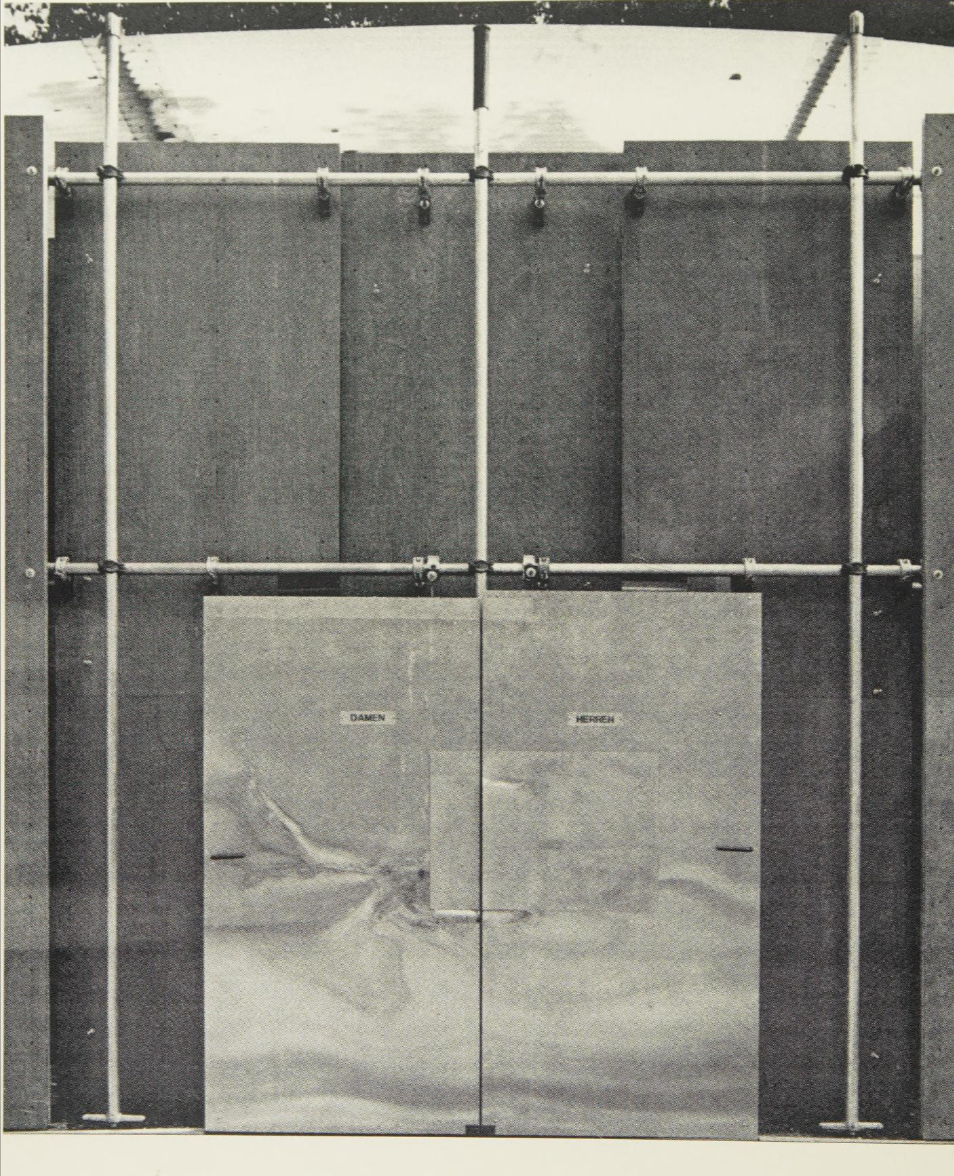
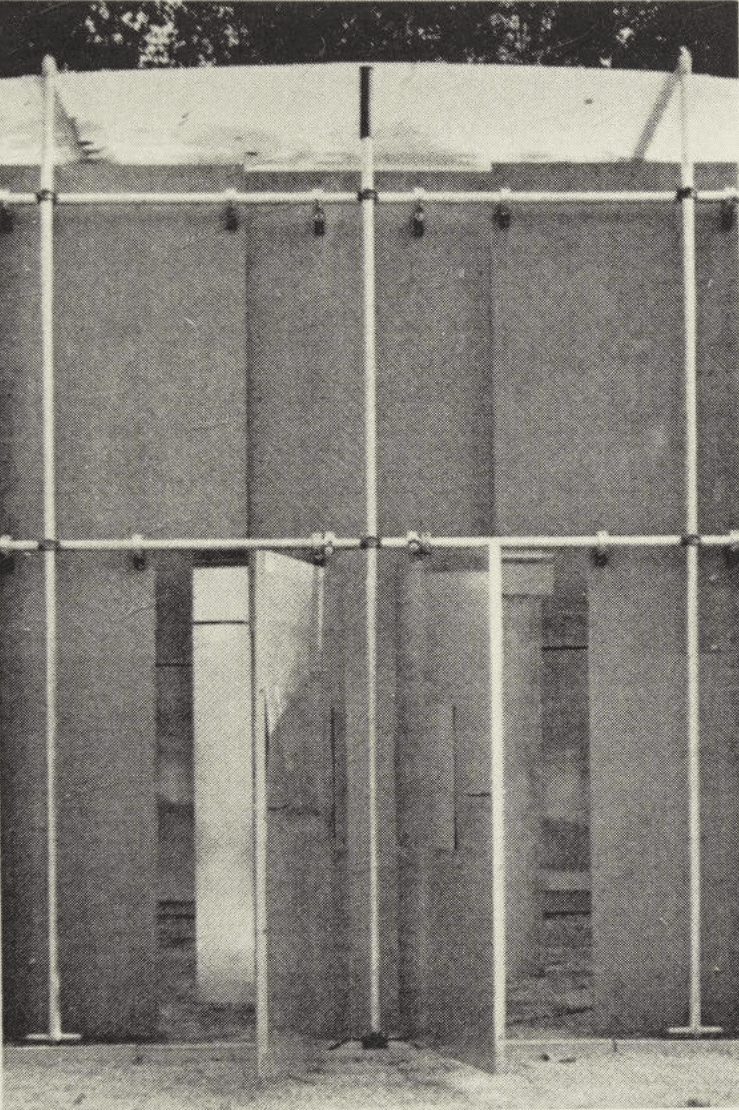
Furthermore, looking into the work of Silvia Federici we can see how the gendering of the doors occurs. Notice how violent the identification of the genders are, the distinguishing sex features are burned into our vulnerabilities. Similar to how much of gender is not a performance by choice but done under duress by coercive pressure. We don’t perform the mother or the father, we are disciplined into it by social extortion.
Violence
Toilets are separated by sex not for hygiene but for moral regulation. In “Divisible by 2”, that morality is not fulfilled. The pavilion mocks the moral, betrays it by perverting the familiar symbols that allow for passive gender performance. In doing so it reveals the emptiness and fragility of a system that depends on unconscious compliance to survive, and the fragility of an architecture that relies on habit to remain unquestioned.
For many, gender operates as a primary source of self-esteem and identity. This reliance is why people perform gendered behaviors that offer no logical benefit, yet align with an internalized image of the self. When the stability of these categories is disrupted, fear emerges. Their self image is challenged and they are forced to reckon with the compromises, repressions, and violence of their own gendered performance. Jealousy, resentment, shame, and humiliation surface alongside a sense of powerlessness. The firebombing of the pavilion emerges from this volatile terrain. When the self identity feels threatened, the body will do what ever is necessary to reassert its moral order.
Granting Sainthood
Ordination and ordinary have the same linguistic root, the ordinary, then, shouldn’t be passively accepted but seen as an active choice continuously reaffirmed. We anoint our choices with the title of “ordinary” or “normal” to avoid confronting the parts of us that we would rather leave unexamined. By showing how even the simplest social construction is theater, the pavilion insists that what appears natural is always rehearsed. Reminding us that “worlds are made as much as found”.
In this sense, the pavilion deserves architectural sainthood. Being burnt at the stake should of been it’s canonisation. Through the fire, it became an architectural martyr, bearing witness to a truth that could not be endured within the moral order it exposed. The flames that attempted to erase it instead intensified its meaning. Its absence continues to perform, lingering as a trace of what was briefly made visible: the instability of gendered space and our rigid obedience to the ordinary.
Despite this, Divisible by 2 is not in our history books nor is it taught in our architecture schools. The pavilion’s exclusion from architectural canon is not an accident of history, but a continuation of the same defensive logic that produced its destruction. Divisible by 2 died for our architectural sins and we’ve purposefully forgotten it. We don’t want to engage with the questions it forced into view. We don’t want to have to face the fact that our buildings are political, that what we design is coercive. Architecture has the capacity to demand participation, to compel bodies into performance, and legitimise ideology.
We must start to deconstruct the way we build, look at the habitual effects of design choices. Gender divided bathrooms may seem normal, yet they’ve repeatedly generated moral panics leading to the deaths of LGBT+ individuals. Every design choice carries a history, and every history exerts who can move freely and who cannot. The power of design is in the body not the image. Architecture is at its most radical not in representation but in what it asks us to do.
References
Images by Margherita Krischanitz and John Whiteman
Quotes are from “Divisible by 2” – John Whiteman
Thank you for reading!
If you enjoyed this article, let me know down below 🙂
If you want to discover more interesting architecture projects click here


Really appreciate how you connected theory (Derrida, Beauvoir) to an actual built project. It made me realise how rarely we question why spaces are designed the way they are. Would love to see more examples like this. Are there contemporary projects doing something similar?